
Private label / development
Towel MOQ Explained: What Determines Minimum Order Quantity?
MOQ depends on colour, fabric mass, loom preparation, construction and branding. Nesis commercial production starts from 500 pcs, with selected projects from 300 pcs where technically feasible; special constructions can require materially higher quantities.
Why MOQ is a production requirement
Towel minimum order quantity is the smallest programme that can reasonably support its material preparation, loom setup, dyeing, finishing and branding requirements. It is a consequence of the specification and production route, rather than simply a number chosen by the sales team.
The meaningful question is “minimum for which construction, in how many colours and sizes?” A total of 1,000 pieces divided into many small colour and size lines can be harder to manufacture than 500 pieces in one technically suitable specification. The minimum must be established against the actual order breakdown.
Standard terry and custom constructions have different minimums
| Production route | What creates the minimum | What to clarify |
|---|---|---|
| Piece-dyed terry | Fabric preparation and separate dye lots for each colour | Available construction, finished dimensions and quantity per colour |
| Yarn-dyed stripe | Yarn dyeing by colour, warp preparation and stripe repeat | Yarn colours, stripe widths, repeat, sizes and total fabric requirement |
| Jacquard | Design development, loom configuration and repeat efficiency | Artwork, repeat dimensions, ground/pile structure and colour arrangement |
| Special construction | Dedicated yarn, unusual width, assembly or finishing operations | Feasibility of the complete construction before a piece minimum is quoted |
Piece-dyed terry is woven before its final colour is applied. When a suitable construction can be scheduled with existing production, its setup may be simpler than a dedicated yarn-dyed or jacquard programme. That does not mean every plain towel or custom colour is available at a low minimum.
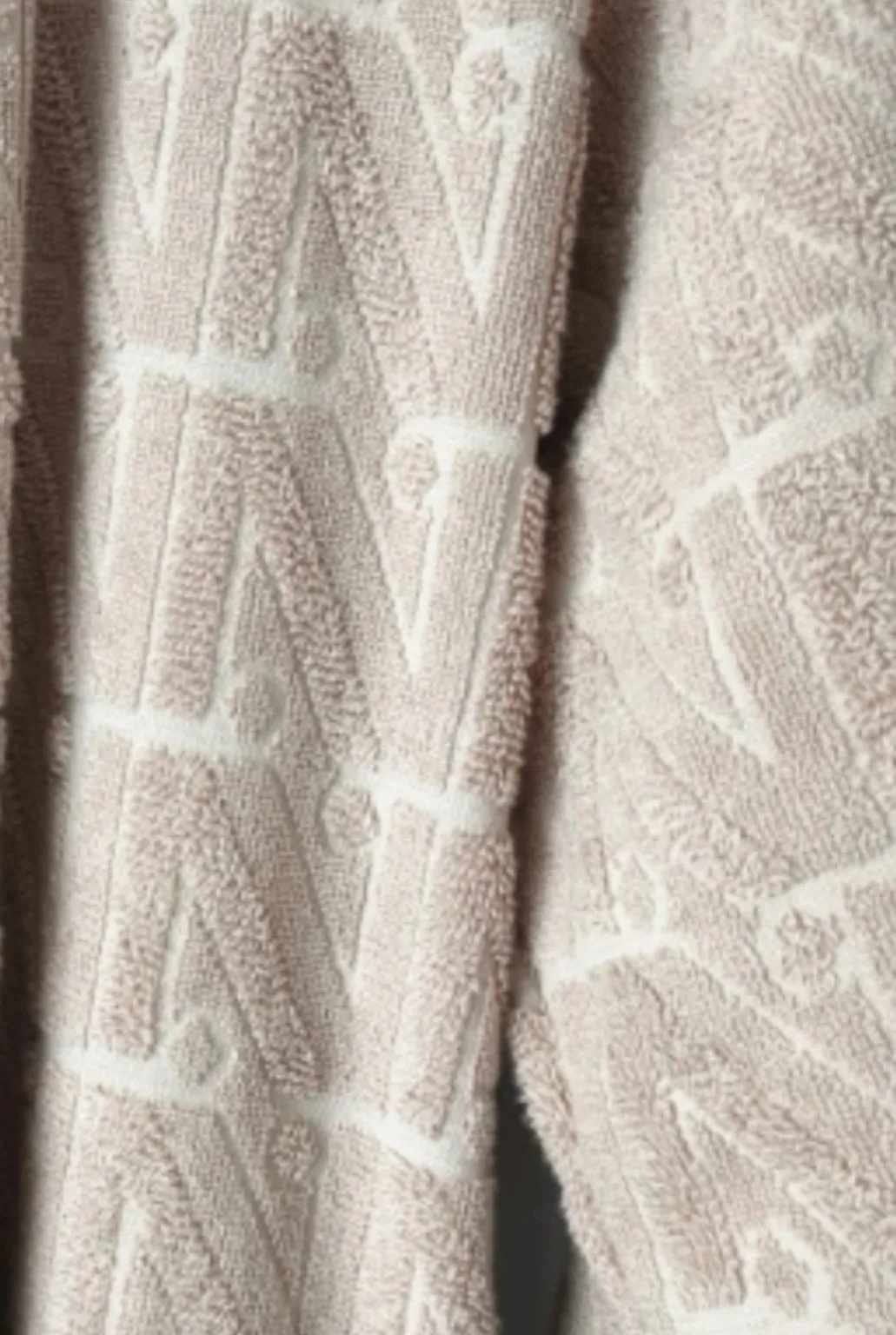
Yarn-dyed stripes require coloured yarn to be arranged in the weave. Jacquard changes the woven design itself. A logo woven into the towel cannot be treated commercially like embroidery applied after weaving. Dedicated preparation can make the minimum materially higher.
Colour, dye lots, GSM and dimensions
Each custom shade can create a separate dyeing requirement. Dyeing is planned around fabric mass and suitable processing capacity, so a piece count alone does not define the dye lot. Ask whether the minimum applies per colour, construction, design or size, and whether compatible sizes can share a production route.
Size and GSM change the amount of fabric in each piece. For example, nominal fabric mass for a 70 × 140 cm towel at 600 GSM is 588 g; 500 pieces represent approximately 294 kg before construction differences. A 30 × 50 cm towel at the same GSM is approximately 90 g, so the same piece count represents a very different fabric requirement. These calculations explain production scale; they are not dye-lot thresholds.
A different GSM can require another construction. Even matching fibre and colour does not automatically allow two GSMs to share one production minimum. Use the GSM and finished-weight reference to estimate fabric mass, then have the manufacturer confirm compatible lines.
Embroidery, labels and packaging create additional requirements
| Detail | Effect on planning | Useful RFQ information |
|---|---|---|
| Embroidery | Digitising, thread selection and machine time; base towel minimum still applies | Logo dimensions, position, colours and artwork |
| Woven brand label | Separate label production and application; label minimum may exceed towel quantity | Label size, fold, design and attachment position |
| Care label | Content and construction must suit the product and destination | Fibre composition, care requirements, language and artwork |
| Packaging | Printing, tooling and assembly can have independent supplier minimums | Units per pack, box/band type, dimensions, printing and barcode |
A stock packaging format with applied branding may have different requirements from a fully custom rigid box. Spare labels or packaging can sometimes be planned for a repeat order, but this must be agreed commercially. Reducing logo complexity may reduce setup cost without reducing the base fabric minimum. Review private-label manufacturing options before treating all customisation as one fixed surcharge.
Nesis commercial framework
Commercial Production from 500 pcs
Selected Projects from 300 pcs where technically feasible. These are programme starting points, not universal guarantees per size, design or colour. Yarn-dyed stripe, jacquard and technically complex constructions may require materially higher quantities.
Very small programmes spread setup and development costs across fewer pieces. They can also fall below practical material or processing requirements. Simplifying a first collection to fewer compatible sizes, one colour or a feasible existing construction can make review more productive, without assuming the factory can combine unrelated specifications.
The production sequence is technical/commercial confirmation → 60% advance → production setup → first finished pieces from actual production → photo/video documentation → courier evaluation where required → production continuation under the approved setup → 40% balance → dispatch. First finished pieces confirm the agreed construction, positioning and finishing; they are not an open redesign stage. Timing is confirmed for the project.
Ask for the real minimum with an accurate RFQ
Send application, size, GSM or target piece weight, fibre, construction, colour reference, quantity per size/design/colour, artwork, labels, packaging and destination. Identify essential requirements and acceptable alternatives. A manufacturer can then explain which operation sets the minimum and whether a simpler route is technically feasible.
Use the towel RFQ checklist or review custom towel development before submitting your production review request. Ask for the quoted minimum to be stated against each order line, with separate packaging or branding minimums where applicable.
Request Production Review
Send your application, dimensions, construction, colour, quantity, branding and delivery market for a project-specific production review.
Request Production ReviewNesis Textile · Production in Denizli, Türkiye · B2B manufacturing and procurement guidance. Technical performance and commercial feasibility must be confirmed for the agreed programme.