
Hospitality procurement
Hotel Towel Procurement Guide: GSM, Construction, Laundry & Specification
Hotel towel procurement should balance guest feel with laundering, drying capacity, durability and repeat supply. Define the operating requirements first, then specify GSM, yarn, pile, size and finishing together.
Specify the operating requirement before the GSM
A hotel towel must work for guests, housekeeping and the laundry. Begin with room type, intended use, wash frequency, laundry equipment and drying capacity, storage, replacement planning and branding. A heavier towel may meet a desired guest feel while adding dry textile mass to each laundry load.
Compare constructions against these requirements rather than assigning quality from GSM alone. Purchase price per piece also needs context: dimensions, yarn, pile, borders, hems, branding and delivery scope all change what is being bought. There is no single construction that is best for every property.
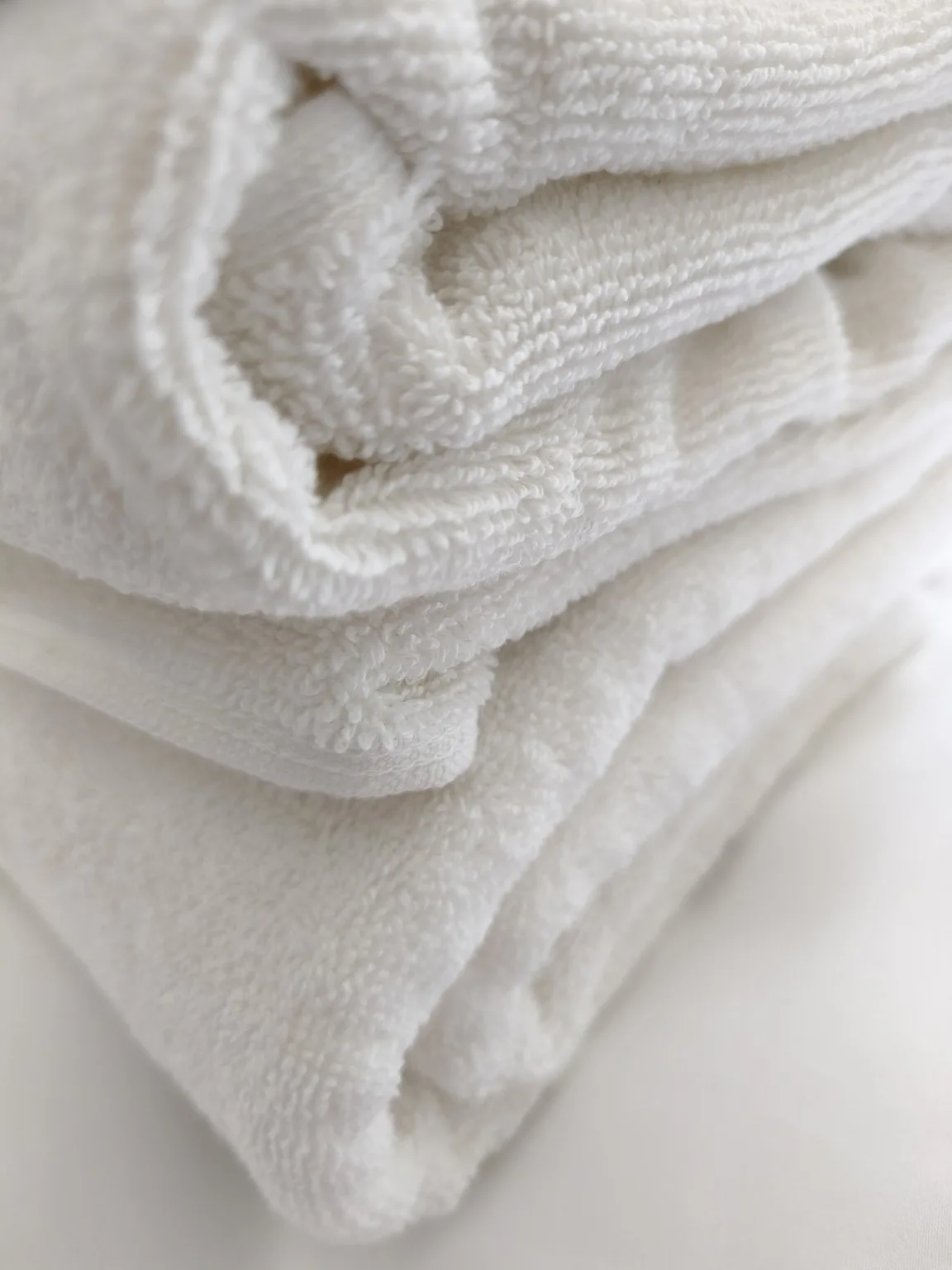
Build a coherent size and category programme
| Category | Illustrative dimensions | Procurement decision |
|---|---|---|
| Face / washcloth | 30 × 30 cm | Guest use, presentation and laundering/handling requirements |
| Guest / small hand towel | 30 × 50 cm or 40 × 80 cm | Room layout and intended use; category naming differs by market |
| Hand towel | 50 × 90 cm or 50 × 100 cm | Rail space, practical coverage and consistent folding |
| Bath towel | 70 × 140 cm or 90 × 150 cm | Coverage, guest positioning, packed mass and laundry turnaround |
| Bath sheet | 100 × 150 cm or 100 × 180 cm | Larger coverage balanced against storage and load mass |
| Bath mat | For example, 50 × 70 cm | Dedicated floor-use construction, absorbency and the operational care process |
These are planning examples, not mandatory hotel standards. Use the property’s rail, shelf and bathroom layout, and confirm dimensions in a consistent supplied or laundered measurement condition. A bath mat should be specified as a separate product rather than assumed to be a small bath towel.
Record each SKU and quantity. Replacement needs may differ between categories, so avoid assuming every future order will use the original set ratio.
Choose GSM, yarn, pile and finishing together
GSM describes mass per square metre. Nominal fabric weight for 70 × 140 cm is 490 g at 500 GSM and 588 g at 600 GSM. For 500 pieces that difference is approximately 49 kg of textile mass before construction differences. It is a planning calculation, not a drying-time or energy saving claim.
Read the finished-weight chart for other dimensions and the GSM guide for construction context. The target should be a balanced product specification, not the highest available number.
Ring-spun yarn can be a useful starting point where repeated use and a defined pile are priorities. Yarn count, twist, fibre preparation, loop height, pile density, ground construction and hems still matter. Low-twist and zero-twist options should be evaluated under the intended care process rather than ruled in or out by name; use the yarn construction comparison to frame that review.
Assess water wetting and uptake on the actual finished towel. Initial hand feel can be influenced by finishing. A plush appearance does not prove absorbency, and softness should be reviewed after the agreed laundering process as well as on delivery.
Coordinate the specification with the commercial laundry
Laundering direction
60°C is suitable for hospitality programmes where the agreed product care permits it. Occasional higher-temperature laundering may be used where operationally required and compatible with the product. Continuous unnecessarily high-temperature laundering can reduce textile service life. Confirm the process for the complete article, including colour, embroidery and labels.
Temperature alone does not define a laundry process. Share detergent/chemical use, extraction, mechanical action, drying and finishing with the supplier. Where the operation has specific hygiene requirements, the responsible laundry should establish its process and verify textile compatibility; this guide is not a disinfection protocol.
Greater fabric mass usually creates more material to dry, but residual water after extraction, airflow, equipment and pile structure also affect turnaround. Do not translate GSM directly into a fixed drying cycle or energy cost. Review candidate constructions with the operating laundry and follow machine load limits.
Record the supplied condition and evaluate representative production pieces under consistent conditions. Check dimensions, appearance, absorbency, pile stability, lint, borders and hems. Agree acceptance criteria for the programme rather than relying on a universal number of wash cycles.
White, colour and branding: practical trade-offs
White versus custom colour
White can simplify appearance consistency and the grouping of compatible products, but its laundry chemistry must still suit the towel. Custom colour can support a property identity while introducing shade approval, dye-lot and colourfastness requirements. Repeat shades should be reviewed against a retained physical reference under agreed conditions.
Do not assume coloured towels tolerate the same chemical treatment as white goods. Specify the intended care and any relevant colourfastness assessment. Custom dyeing can also affect minimums and scheduling; the MOQ guide explains the production implications.
Embroidery and labels
Define logo dimensions, thread colours, position and backing. A dense logo may alter local feel, drape and drying; suitable border or corner placement may better preserve the main drying surface. Evaluate the complete branded article rather than approving an unbranded towel and assuming identical behaviour.
Care labels and woven brand labels should be readable and securely attached for the intended use. Confirm their content, destination requirements and washing compatibility. A retail gift box may suit a spa shop, while hotel room supply may use simpler bulk packing; quote those separately.
Protect replacement and repeat-order consistency
Retain a master specification and a reference from the confirmed production. Record product code, fibre, yarn/construction, dimensions and measurement basis, GSM/target weight, border and hem details, shade reference, branding, labels and packaging. Approve any change to the specification before the next run.
Record quantities per SKU, anticipated replacement needs and delivery requirements. Matching colour names or GSM alone is insufficient for repeat consistency. Ask the supplier to confirm availability and any changes in material, construction or finishing before reordering.
Commercial production at Nesis starts from 500 pcs; selected projects may be evaluated from 300 pcs where technically feasible. Custom constructions can require higher minimums. A repeat programme still needs construction-specific commercial review; it is not a promise of ready stock or immediate replenishment.
Hotel procurement brief and production confirmation
- Property/application and towel categories, with quantity per size and colour.
- Dimensions, measurement condition, GSM and proposed yarn/construction.
- Guest feel, absorbency and operating laundry requirements.
- Borders, hems, bath mat construction and branding details.
- Required documents, tests and agreed acceptance criteria.
- Packing, delivery country/postcode and required arrival date.
- Repeat-order reference and replacement planning.
Use the RFQ checklist to turn these decisions into a comparable quotation. Explore hotel towel manufacturing and the wider hotel textile programme.
After technical/commercial confirmation and 60% advance, production setup leads to the first finished pieces from actual production. Photo/video documentation and courier evaluation where required confirm agreed construction, positioning and finishing. These pieces are not an open redesign stage. Production continues under the approved setup, with 40% balance before dispatch. The schedule is confirmed for the project.
Discuss a Hotel Textile Programme
Send your application, dimensions, construction, colour, quantity, branding and delivery market for a project-specific production review.
Request Production ReviewNesis Textile · Production in Denizli, Türkiye · B2B manufacturing and procurement guidance. Technical performance and commercial feasibility must be confirmed for the agreed programme.